

Above: Undergraduate Savannah Strongman presenting in Les Guliasi’s Bending the Curve: Climate Education for All class (photo by Carolyn Lagatutta)
Between disastrous fires and hurricanes, sea-level rise, and continuing species extinction, the topic of climate change can feel overwhelming.
But an empowering course at UC Santa Cruz offers a starting point for taking action.
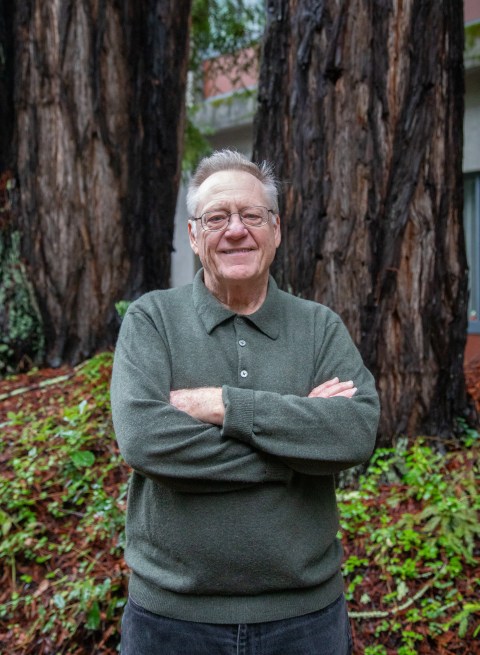
sociology researcher and Baskin Engineering lecturer Les Guliasi brings his vibrant teaching style and rich background to the course. (Photo by Carolyn Lagattuta)
Bending the Curve: Climate Education for All is an innovative, solutions-oriented course, developed and regularly updated by the UC system, that features a dazzling array of subject-expert video lecturers, in-class activities, instructor resources, supplemental readings, and a rich multimedia content library. This for-credit undergraduate course is open to students from all majors and can be individually tailored by the teaching professor to match the needs and interests of diverse cohorts of students.
Whether students are interested in environmental science, the humanities, engineering, politics, journalism, the social sciences, or virtually any other subject, the course has something for everyone. With no prerequisites, Bending the Curve—an Electrical and Computer Engineering Department and Rachel Carson College course at UCSC—is designed to appeal to all students from all departments who care about climate change and environmental and social justice and want to learn practical steps for making a positive difference.
Derede Arthur, a senior lecturer in UCSC’s Writing Program, audited Bending the Curve in 2021 and felt so inspired that she became a student adviser and mentored a group of classmates who wanted to form a climate coalition and increase student activism on campus. Then she helped form a faculty climate group—UCSC Climate Action Now (CAN)— whose 60-plus members are committed to environmental justice, climate education, and promoting actions aimed at reversing the growing threat of climate change.
“Bending the Curve offers a way to look at and act on the climate crisis from angles you wouldn’t normally see. In a quarter, you couldn’t possibly teach all the materials available,” Arthur said. “It has so many built-in resources and faculty lectures from many walks of disciplinary expertise. Right from the start, this course speaks to students’ strong desire for social justice, solving problems, and making the world not just safer but more equitable.”
Aiming for solutions
UCSC’s Bending the Curve course has a particularly interesting focus, thanks to sociology researcher and Baskin Engineering lecturer Les Guliasi (M.A. ’77, sociology; Ph.D. ’18), who brings his vibrant teaching style and rich background in sociology, energy policy, and business to the course. Because this course has been taught by different kinds of professors across the UC system—engineers, environmental scientists, life scientists, physical scientists—it is flexible enough to be adapted to what a particular professor wants to teach.
“For example, Bending the Curve has a module on social justice. All instruction is rooted in the fundamentals and science leading toward solutions,” said Guliasi, adding that his interest is policy, which may add appeal to students who care about social, environmental, and/or energy policy.
Guliasi and Arthur have been thrilled by students’ reaction to Bending the Curve and were particularly delighted when students felt so inspired by the course that they worked together to create and champion a student-led, action-oriented climate coalition and annual climate conference—both of which continue to flourish at UCSC.
“The two things we can be most proud of from Bending the Curve are the student climate coalition, now called Sunrise, and the annual student-run climate conference, which gives students the opportunity to organize and experience the format of a professional conference,” Guliasi said.
Sunrise, the student-led climate coalition of about 850 UCSC students, faculty, and staff, was founded in 2021 to push for more climate education and for campus decarbonization. Sunrise members organize the annual student climate conference, and their activities and achievements include an Earth Day Teach-In, campus hikes and movie nights, speaker sponsorships, and advocacy to help UCSC be a true climate leader that champions climate justice and fossil-free campus operations. Sunrise participates in the UC Green New Deal Coalition, an approximately 1,000-member organization advocating a “UC Green New Deal” policy platform centering on campus decarbonization, climate education, and environmental justice.
As founders of the student climate coalition, alumni Gwen Parden (Oakes ’23, anthropology), Maya Caminada (Porter ’23, anthropology), and Katie Seal Jorczak (Merrill ’23, anthropology) were part of the enthusiastic student team that organized the first annual UCSC student climate conference in 2022. The following year, hundreds of people attended “Shifting the Story: Climate Vulnerability, Social Solidarity, Environmental Justice,” which showcased research papers, academic posters, art, music and dance, student panels and discussions, free food, and more.

Left to right: Alumni Gwen Parden (Oakes ’23, anthropology), Maya Caminada (Porter ’23, anthropology), and Katie Seal Jorczak (Merrill ’23, anthropology)
Sunrise is planning for a 2025 student climate conference this fall.
Seed of a movement
Bending the Curve: Climate Change Solutions was created by UC San Diego’s Ram Ramanathan, a climate scientist and physical oceanographer who is passionate about climate change and believes that all students in the UC system should have a course dealing with this critical issue, said Guliasi.
After designing the course, Ramanathan got other UCSD professors involved before approaching the UC Office of the President with a proposal to expand the course beyond UCSD and offer it systemwide. He recruited faculty from across the UC system to develop prerecorded lectures and PowerPoint presentations, and in spring 2018 the course launched simultaneously on five UC campuses. Since then, more than 2,000 students across seven UC undergraduate campuses have completed Bending the Curve.
At UC Santa Cruz, the class straddles the Baskin School of Engineering and Social Sciences divisions, an example of the university’s interdisciplinary efforts to tackle some of the world’s most pressing challenges. The class was brought into the Electrical and Computer Engineering Department as part of an overall commitment to ensuring engineering students explore the societal impacts of the technology they learn about and create.
“Baskin Engineering students are exposed to a range of opportunities to learn about the implications of the work we do as engineers, and Bending the Curve is a great example of that within a classroom setting,” said Alexander Wolf, Dean of Baskin Engineering. “Investigating solutions to climate challenges is a particular area of focus. This class provides a unique setting in which students from across campus can engage with the topic in community, bringing a variety of different lenses to the questions raised by the course.”
While the course is currently offered once a year, there is motivation to expand the class so more students can get involved.
“At such a crucial moment for increasing the focus on climate action, we are looking into ways to bring this class to more students. As we see attention at the national level shifting around climate change, we have an opportunity to provide more leadership on this issue at the state level,” said Anne Criss, assistant dean of Baskin Engineering who is leading the development of climate solutions initiatives at the school.
Alumni continue the bend
Bending the Curve alumni continue to express enthusiasm for the course, citing a sense of empowerment; new friendships, connections, and networking opportunities; stimulating lectures and discussions; and meaningful experiences during their time at UCSC and beyond.
“I took Bending the Curve in my first quarter at UCSC and was so impressed,” said Parden, who now works in engagement and administration for the Land Trust of Santa Cruz. “The founders of the climate coalition all met in that course. Derede Arthur came in for a guest lecture one day and expressed her frustration with the lack of activism on campus after the pandemic. A few of us agreed that was frustrating and thought, ‘Why don’t we start something up?’”
Jorczak, a social worker at a residential addiction recovery facility, said she loved being involved in the climate coalition.
“I was a part of the steering committee and helped plan and execute the Earth Day events and the climate conference,” Jorczak said. “We had ample support and guidance from professors, such as Derede and Les, and I’m proud of the consistent collaborative effort from the students. It was so motivating to turn our passion for addressing climate change into meaningful action.”
Caminada, who transferred to UCSC after studying abroad and working with Indigenous people in the Ecuadorian Amazon, said Bending the Curve was one of her favorite classes at UCSC.

Students and organizers after the 2022 student-led climate change conference
“I think what makes the class so special is Les,” said Caminada, who is now studying law at the University of Illinois Chicago, with an eye toward environmental and international human rights law. “He’s a really wonderful teacher and helped us so much with organizing in our future work and for the climate coalition. He’s a teacher who really listens to his students and wants to provide very interesting coursework. Bending the Curve was definitely an empowering class because you did have space to talk about these hard topics and how they would affect your life, while also working through ideas and practical steps toward solutions.”
Lasting friendships have blossomed in the course, and Arthur and Guliasi pointed out that employers and graduate schools are looking for students to show leadership and collaborative thinking.
“The [student climate] conference has been useful for students applying for jobs and getting into graduate schools,” Guliasi said. “That’s something that I place prominently when writing letters of recommendation: that their leadership went beyond what students normally do.”
Open doors
Parden, Caminada, and Jorczak met and became friends in Bending the Curve. They remain close today, and all said they continue to appreciate the many opportunities and connections that have developed out of their taking the course.
“This class has opened so many doors for us, and it continues to do so,” Caminada said. “Gwen and I have been able to create full lives and careers from what we’ve learned in our environmental activism in that field, and that only came about because we connected to others through Bending the Curve. It really was a touchstone in my education and career. I’m grateful for that time and would definitely say to anyone who can, to take the course.”
Students may wonder why, if it’s not necessary for their degree or if they’re not majoring in an area like environmental science, they would need to take a class on climate change.
“From a business side, businesses—no matter what industry—will be affected by climate change,” said Parden. “If they’re not already, they will be. Having a working knowledge of what that looks like in your future career is really powerful.” Jorczak agrees.
“I saw a quote shared anonymously during the recent Los Angeles wildfires that sums it up perfectly,” she said. “‘Climate change will manifest as a series of disasters viewed through phones with footage that gets closer and closer to where you live, until you’re the one filming it.’”
“But I also want to emphasize that there are so many amazing people contributing to a more positive world that centers the environment, and they will continue to fight every day,” Jorczak added. “Never lose hope, and remember that we always have each other.”
Editor’s note: The Bending the Curve e-textbook and selected resources are available free online to all.